


Tampilkan postingan dengan label POS. Tampilkan semua postingan
Tampilkan postingan dengan label POS. Tampilkan semua postingan
Selasa, 19 Agustus 2014
Nominal Adjectives
Nominal Adjectives
Certain adjectives are used to denote a class by describing one of the attributes of the class. For example, the poor denotes a class of people who share a similar financial status. Other nominal adjectives are:
the sick the wealthy the blind the innocent
the British the Japanese
the Russians the Americans the Poles Nominal adjectives do not refer exclusively to classes of people. Indeed some of them do not denote classes at all:
the contrary the good
the elder of the two the greatest of these the most important among them
| |

Stative and Dynamic Adjectives
Stative and Dynamic Adjectives
As their name suggests, STATIVE adjectives denote a state or condition, which may generally be considered permanent, such as big,red, small. Stative adjectives cannot normally be used in imperative constructions:- *Be big/red/small
- *He is being big/red/small
- Be brave!
| calm careful cruel disruptive foolish friendly good impatient | mannerly patient rude shy suspicious tidy vacuous vain |
All dynamic adjectives can be used in imperatives (Be careful!, Don't be cruel!), and they can also be used predicatively in progressive constructions:
- Your son is being disruptive in class
My parents are being foolish again
We're being very patient with you
Attributive and Predicative Adjectives
Characteristics of Adjectives
Characteristics of Adjectives
Adjectives can take a modifying word, such as very, extremely, orless, before them:- very cold weather
extremely large windows
less violent storms
Here, the modifying word locates the adjective on a scale of comparison, at a position higher or lower than the one indicated by the adjective alone.
This characteristic is known as GRADABILITY. Most adjectives are gradable, though if the adjective already denotes the highest position on a scale, then it is non-gradable:
| my main reason for coming | ~*my very main reason for coming |
| the principal role in the play | ~*the very principal role in the play |
As well as taking modifying words like very and extremely,adjectives also take different forms to indicate their position on a scale of comparison:
The lowest point on the scale is known as the ABSOLUTE form, the middle point is known as the COMPARATIVE form, and the highest point is known as the SUPERLATIVE form. Here are some more examples:
In most cases, the comparative is formed by adding -er , and the superlative is formed by adding -est, to the absolute form. However, a number of very common adjectives are irregular in this respect:
Characteristics of Adjectives
Adjectives can take a modifying word, such as very, extremely, orless, before them:- very cold weather
extremely large windows
less violent storms
Here, the modifying word locates the adjective on a scale of comparison, at a position higher or lower than the one indicated by the adjective alone.
This characteristic is known as GRADABILITY. Most adjectives are gradable, though if the adjective already denotes the highest position on a scale, then it is non-gradable:
| my main reason for coming | ~*my very main reason for coming |
| the principal role in the play | ~*the very principal role in the play |
As well as taking modifying words like very and extremely,adjectives also take different forms to indicate their position on a scale of comparison:
The lowest point on the scale is known as the ABSOLUTE form, the middle point is known as the COMPARATIVE form, and the highest point is known as the SUPERLATIVE form. Here are some more examples:
In most cases, the comparative is formed by adding -er , and the superlative is formed by adding -est, to the absolute form. However, a number of very common adjectives are irregular in this respect:
Some adjectives form the comparative and superlative using moreand most respectively:
Some adjectives form the comparative and superlative using moreand most respectively:
Count and Non-count Nouns
 Count and Non-count Nouns | |||||
Common nouns are either count or non-count. COUNT nouns can be "counted", as follows:
Some common nouns may be either count or non-count, depending on the kind of reference they have. For example, in I made a cake, cakeis a count noun, and the a before it indicates singular number. However, in I like cake, the reference is less specific. It refers to "cake in general", and so cake is non-count in this sentence. | |||||
Common and Proper Nouns

Common and Proper Nouns
Nouns which name specific people or places are known as PROPER NOUNS.- John
Mary
London
France
- John Wesley
Queen Mary
South Africa
Atlantic Ocean
Buckingham Palace
- January, February, Monday, Tuesday, Christmas, Thanksgiving
Since proper nouns usually refer to something or someone unique, they do not normally take plurals. However, they may do so, especially when number is being specifically referred to:
- there are three Davids in my class
we met two Christmases ago
- it's nothing like the America I remember
my brother is an Einstein at maths
Characteristics of Nouns

Characteristics of Nouns
Many nouns can be recognised by their endings. Typical noun endings include:| -er/-or | actor, painter, plumber, writer |
| -ism | criticism, egotism, magnetism, vandalism |
| -ist | artist, capitalist, journalist, scientist |
| -ment | arrangement, development, establishment, government |
| -tion | foundation, organisation, recognition, supposition |
Most nouns have distinctive SINGULAR and PLURAL forms. The plural of regular nouns is formed by adding -s to the singular:
| car | cars |
| dog | dogs |
| house | houses |
However, there are many irregular nouns which do not form the plural in this way:
| man | men |
| child | children |
| sheep | sheep |
We can recognise many nouns because they often have the, a, or anin front of them:
- the car
an artist
a surprise
the egg
a review
- the boy's pen
a spider's web
my girlfriend's brother
John's house
- the boys' pens
the spiders' webs
the Browns' house
Nouns often co-occur without a genitive marker between them:
- rally car
table top
cheese grater
University entrance examination
Common and Proper Nouns
Nouns which name specific people or places are known as PROPER NOUNS. - John
Mary
London
France
- John Wesley
Queen Mary
South Africa
Atlantic Ocean
Buckingham Palace
- January, February, Monday, Tuesday, Christmas, Thanksgiving
Since proper nouns usually refer to something or someone unique, they do not normally take plurals. However, they may do so, especially when number is being specifically referred to:
- there are three Davids in my class
we met two Christmases ago
- it's nothing like the America I remember
my brother is an Einstein at maths
The Ordering of Determiners
 The Ordering of Determiners | |||||||||||
Determiners occur before nouns, and they indicate the kind of reference which the nouns have. Depending on their relative position before a noun, we distinguish three classes of determiners.
PredeterminersPredeterminers specify quantity in the noun which follows them, and they are of three major types: 1. "Multiplying" expressions, including expressions ending in times:
double my salary ten times my salary
one-third my salary
both my salaries
Central DeterminersThe definite article the and the indefinite article a/an are the most common central determiners:
half a chapter
all his/her money all our money all their money
twice that size four times this amount PostdeterminersCardinal and ordinal numerals occupy the postdeterminer slot:
his fourth birthday
our last meeting your previous remark her subsequent letter
our several achievements the few friends that I have
several other people | |||||||||||
Pronouns and Determiners
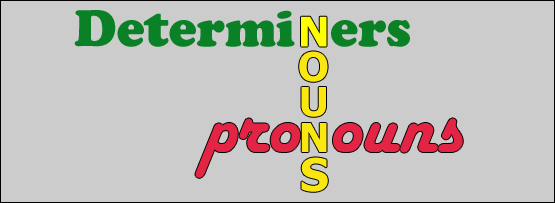
There is considerable overlap between the determiner class and the subclass of pronouns. Many words can be both:
| |||||||||||||||||||||||||||
Numerals and Determiners

Numerals and Determiners
Numerals are determiners when they appear before a noun. In this position, cardinal numerals express quantity:- one book
two books
twenty books
- first impressions
second chance
third prize
- next week
last orders
previous engagement
subsequent developments
- the two of us
the first of many
- five twos are ten
Sabtu, 04 Februari 2012
Types of Verbs
Types of Verbs
Group I Normal Verbs
Most verbs are "Normal Verbs." These verbs are usually physical actions which you can see somebody doing. These verbs can be used in all tenses.Normal Verbs
to run, to walk, to eat, to fly, to go, to say, to touch, etc.
Examples:
- I eat dinner every day.
- I am eating dinner now.
Group II Non-Continuous Verbs
The second group, called "Non-Continuous Verbs," is smaller. These verbs are usually things you cannot see somebody doing. These verbs are rarely used in continuous tenses. They include:Abstract Verbs
to be, to want, to cost, to seem, to need, to care, to contain, to owe, to exist...Possession Verbs
to possess, to own, to belong...Emotion Verbs
to like, to love, to hate, to dislike, to fear, to envy, to mind...
Examples:
- He is needing help now. Not Correct
- He needs help now. Correct
- He is wanting a drink now. Not Correct
- He wants a drink now. Correct
Group III Mixed Verbs
The third group, called "Mixed Verbs," is the smallest group. These verbs have more than one meaning. In a way, each meaning is a unique verb. Some meanings behave like "Non-Continuous Verbs," while other meanings behave like "Normal Verbs."Mixed Verbs
to appear, to feel, to have, to hear, to look, to see, to weigh...List of Mixed Verbs with Examples and Definitions:
to appear:- Donna appears confused. Non-Continuous Verb
Donna seems confused. - My favorite singer is appearing at the jazz club tonight. Normal Verb
My favorite singer is giving a performance at the jazz club tonight.
- I have a dollar now. Non-Continuous Verb
I possess a dollar. - I am having fun now. Normal Verb
I am experiencing fun now.
- She hears the music. Non-Continuous Verb
She hears the music with her ears. - She is hearing voices. Normal Verb
She hears something others cannot hear. She is hearing voices in her mind.
- Nancy looks tired. Non-Continuous Verb
She seems tired. - Farah is looking at the pictures. Normal Verb
She is looking with her eyes.
- John misses Sally. Non-Continuous Verb
He is sad because she is not there. - Debbie is missing her favorite TV program. Normal Verb
She is not there to see her favorite program.
- I see her. Non-Continuous Verb
I see her with my eyes. - I am seeing the doctor. Normal Verb
I am visiting or consulting with a doctor. (Also used with dentist and lawyer.) - I am seeing her. Normal Verb
I am having a relationship with her. - He is seeing ghosts at night. Normal Verb
He sees something others cannot see. For example ghosts, aura, a vision of the future, etc.
- The coffee smells good. Non-Continuous Verb
The coffee has a good smell. - I am smelling the flowers. Normal Verb
I am sniffing the flowers to see what their smell is like.
- The coffee tastes good. Non-Continuous Verb
The coffee has a good taste. - I am tasting the cake. Normal Verb
I am trying the cake to see what it tastes like.
- He thinks the test is easy. Non-Continuous Verb
He considers the test to be easy. - She is thinking about the question. Normal Verb
She is pondering the question, going over it in her mind.
- The table weighs a lot. Non-Continuous Verb
The table is heavy. - She is weighing herself. Normal Verb
She is determining her weight.
Some Verbs Can Be Especially Confusing:
to be:- Joe is American. Non-Continuous Verb
Joe is an American citizen. - Joe is being very American. Normal Verb
Joe is behaving like a stereotypical American. - Joe is being very rude. Normal Verb
Joe is behaving very rudely. Usually he is not rude. - Joe is being very formal. Normal Verb
Joe is behaving very formally. Usually he is not formal.
to feel:
- The massage feels great. Non-Continuous Verb
The massage has a pleasing feeling. - I don't feel well today. Sometimes used as Non-Continuous Verb
I am a little sick.
I am not feeling well today. Sometimes used as Normal Verb
I am a little sick.
Verb Tense Tutorial
Verb Tense Tutorial
Verb tenses are tools that English speakers use to express time in their language. You may find that many English tenses do not have direct translations in your language. That is not a problem. By studying this verb tense tutorial, you will learn to think like a native English speaker. If you prefer to use the verb tense pages as a reference only and do not want to complete the tutorial,
The tutorial should be completed as follows:
1. Read this introduction page.2. Prepare for the exercises by reading: Types of Verbs, Active vs. Passive, and the verb tense descriptions that you want to practice.
3. Complete the exercises below. After each exercise, we have listed the tenses covered. Just click on the name of a tense to learn more about its use.
Langganan:
Postingan (Atom)


