


Tampilkan postingan dengan label Writing Skill. Tampilkan semua postingan
Tampilkan postingan dengan label Writing Skill. Tampilkan semua postingan
Selasa, 19 Agustus 2014
Nominal Adjectives
Nominal Adjectives
Certain adjectives are used to denote a class by describing one of the attributes of the class. For example, the poor denotes a class of people who share a similar financial status. Other nominal adjectives are:
the sick the wealthy the blind the innocent
the British the Japanese
the Russians the Americans the Poles Nominal adjectives do not refer exclusively to classes of people. Indeed some of them do not denote classes at all:
the contrary the good
the elder of the two the greatest of these the most important among them
| |

Stative and Dynamic Adjectives
Stative and Dynamic Adjectives
As their name suggests, STATIVE adjectives denote a state or condition, which may generally be considered permanent, such as big,red, small. Stative adjectives cannot normally be used in imperative constructions:- *Be big/red/small
- *He is being big/red/small
- Be brave!
| calm careful cruel disruptive foolish friendly good impatient | mannerly patient rude shy suspicious tidy vacuous vain |
All dynamic adjectives can be used in imperatives (Be careful!, Don't be cruel!), and they can also be used predicatively in progressive constructions:
- Your son is being disruptive in class
My parents are being foolish again
We're being very patient with you
Inherent and Non-inherent Adjectives
We have now looked at the main criteria for the adjective class - gradability, comparative and superlative forms, and the ability to occur attributively and predicatively. Most adjectives fulfil all these criteria, and are known as CENTRAL adjectives. Those which do not fulfil all the criteria are known as PERIPHERAL adjectives.
All dynamic adjectives can be used in imperatives (Be careful!, Don't be cruel!), and they can also be used predicatively in progressive constructions:
Inherent and Non-inherent Adjectives
Most attributive adjectives denote some attribute of the noun which they modify. For instance, the phrase a red car may be said to denotea car which is red. In fact most adjective-noun sequences such as this can be loosely reformulated in a similar way:| an old man | ~a man who is old |
| difficult questions | ~questions which are difficult |
| round glasses | ~glasses which are round |
This applies equally to postpositive adjectives:
- something understood ~something which is understood
the people responsible ~the people who are responsible
However, not all adjectives are related to the noun in the same way. For example, the adjective small in a small businessman does not describe an attribute of the businessman. It cannot be reformulated asa businessman who is small. Instead, it refers to a businessman whose business is small. We refer to adjectives of this type as NON-INHERENT adjectives. They refer less directly to an attribute of the noun than inherent adjectives do. Here are some more examples, showing the contrast betwen inherent and non-inherent:
| distant hills | distant relatives |
| a complete chapter | a complete idiot |
| a heavy burden | a heavy smoker |
| a social survey | a social animal |
| an old man | an old friend |
Stative and Dynamic Adjectives
As their name suggests, STATIVE adjectives denote a state or condition, which may generally be considered permanent, such as big,red, small. Stative adjectives cannot normally be used in imperative constructions:- *Be big/red/small
- *He is being big/red/small
- Be brave!
| calm careful cruel disruptive foolish friendly good impatient | mannerly patient rude shy suspicious tidy vacuous vain |
All dynamic adjectives can be used in imperatives (Be careful!, Don't be cruel!), and they can also be used predicatively in progressive constructions:
- Your son is being disruptive in class
My parents are being foolish again
We're being very patient with you
Attributive and Predicative Adjectives
Characteristics of Adjectives
Characteristics of Adjectives
Adjectives can take a modifying word, such as very, extremely, orless, before them:- very cold weather
extremely large windows
less violent storms
Here, the modifying word locates the adjective on a scale of comparison, at a position higher or lower than the one indicated by the adjective alone.
This characteristic is known as GRADABILITY. Most adjectives are gradable, though if the adjective already denotes the highest position on a scale, then it is non-gradable:
| my main reason for coming | ~*my very main reason for coming |
| the principal role in the play | ~*the very principal role in the play |
As well as taking modifying words like very and extremely,adjectives also take different forms to indicate their position on a scale of comparison:
The lowest point on the scale is known as the ABSOLUTE form, the middle point is known as the COMPARATIVE form, and the highest point is known as the SUPERLATIVE form. Here are some more examples:
In most cases, the comparative is formed by adding -er , and the superlative is formed by adding -est, to the absolute form. However, a number of very common adjectives are irregular in this respect:
Some adjectives form the comparative and superlative using moreand most respectively:
Some adjectives form the comparative and superlative using moreand most respectively:
The Ordering of Determiners
 The Ordering of Determiners | |||||||||||
Determiners occur before nouns, and they indicate the kind of reference which the nouns have. Depending on their relative position before a noun, we distinguish three classes of determiners.
PredeterminersPredeterminers specify quantity in the noun which follows them, and they are of three major types: 1. "Multiplying" expressions, including expressions ending in times:
double my salary ten times my salary
one-third my salary
both my salaries
Central DeterminersThe definite article the and the indefinite article a/an are the most common central determiners:
half a chapter
all his/her money all our money all their money
twice that size four times this amount PostdeterminersCardinal and ordinal numerals occupy the postdeterminer slot:
his fourth birthday
our last meeting your previous remark her subsequent letter
our several achievements the few friends that I have
several other people | |||||||||||
Pronouns and Determiners
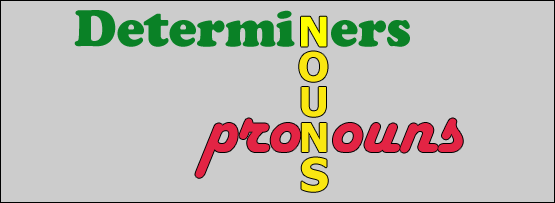
There is considerable overlap between the determiner class and the subclass of pronouns. Many words can be both:
| |||||||||||||||||||||||||||
Numerals and Determiners

Numerals and Determiners
Numerals are determiners when they appear before a noun. In this position, cardinal numerals express quantity:- one book
two books
twenty books
- first impressions
second chance
third prize
- next week
last orders
previous engagement
subsequent developments
- the two of us
the first of many
- five twos are ten
Senin, 18 Agustus 2014
Auxiliary Verbs

Auxiliary Verbs are the verbs be, do, have, will when they are followed by another verb (the full verb) in order to form a question, a negative sentence, a compound tense or the passive.
The verb "be"
The verb be can be used as an auxiliary and a full verb. As an auxiliary we use this verb for compound tenses and the passive voice. Note that be is an irregular verb:
- Simple Present:
- I am, he/she/it is, we/you/they are
- Simple Past:
- I/he/she/it was, we/you/they were
- Past Participle:
- been
You can tell that in the following sentences be is an auxiliary because it is followed by another verb (the full verb). (For progressive forms use the "-ing" form of the full verb; for passive voice, use the past participle of the full verb.)
Progressive Forms
- Present Progressive:
- He is playing football.
- Past Progressive:
- He was playing football.
- Present Perfect Progressive:
- He has been playing football.
- Past Perfect Progressive:
- He had been playing football.
Passive
- Simple Present/Past:
- The house is/was built.
- Present/Past Perfect:
- The house has/had been built.
- Future I:
- The house will be built.
"be" as a full verb
The verb be can also be a full verb. In this case, it's not followed by another verb. If be is used as a full verb, we do not need an auxiliary in negative sentences or questions.
- positive sentence:
- They are fifteen years old.
- negative sentence:
- They are not fifteen years old.
- question:
- Are they fifteen years old?
The verb "have"
The verb have, too, can be used both as an auxiliary and as a full verb. As an auxiliary we use this verb to form compound tenses in active and passive voice. (Use the past participle of the full verb.)
Compound Tenses - Active Voice
- Present Perfect Simple:
- He has played football.
- Past Perfect Simple:
- He had played football.
- Present Perfect Progressive:
- He has been playing football.
- Past Perfect Progressive:
- He had been playing football.
Compound Tenses - Passive Voice
- Present/Past Perfect:
- The house has/had been built.
Note that have is an irregular verb, too:
- Simple Present:
- I/we/you/they have, he/she/it has
- Simple Past:
- I/he/she/it/we/you/they had
- Past Participle:
- had
"have" in positive sentences
As a full verb have indicates possession. In British English, however, we usually use have got (have being the auxiliary, got the full verb).
- full verb:
- I have a car.
- auxiliary verb:
- I have got a car.
"have" in negative sentences and questions
When we use have as a full verb, we must use the auxiliary do in negative sentences and questions. If we use have got, however, we do not need another auxiliary.
- have as a full verb:
- I do not have a car.
- Do I have a car?
- have as an auxiliary verb:
- I have not got a car.
- Have I got a car?
The verb "will"
The verb will can only be used as an auxiliary. We use it to form the future tenses.
The auxiliary verb "will"
- Future I:
- He will not play football.
- Future II:
- He will have played football.
The verb will remains the same for all forms (no "s" for 3rd person singular). The short form for negative sentences is won't.'
- Examples:
- I will, he will
- I will not = I won't
The verb "do"
The verb do can be both an auxiliary and a full verb. As an auxiliary we use do in negative sentences and questions for most verbs (except not for be, will, have got and modal verbs) in Simple Present and Simple Past. (Use the infinitive of the full verb.)
The auxiliary "do" in negative sentences
- Simple Present:
- He does not play football.
- Simple Past:
- He did not play football.
The auxiliary "do" in questions
- Simple Present:
- Does he play football?
- Simple Past:
- Did he play football?
The verb do is irregular:
- Simple Present:
- I/we/you/they do, he/she/it does
- Simple Past:
- I/he/she/it/we/you/they did
The full verb "do"
As a full verb we use do in certain expressions. If we want to form negative sentences or questions using do as a full verb, we need another do as an auxiliary.
- positive sentence:
- She does her homework every day.
- negative sentence:
- She doesn't do her homework every day.
- question:
- Does she do her homework every day?
Sentences without the auxiliary "do"
In the following cases, the auxiliary do is not used in negative sentences/questions:
the full verb is "be"
- Example:
- I am not angry. / Are you okay?
the sentence already contains another auxiliary (e.g. have, be, will)
- Example:
- They are not sleeping. / Have you heard that?
the sentence contains a modal verb (can, may, must, need, ought to, shall, should)
- Example:
- We need not wait. / Can you repeat that, please?
the question asks for the subject of the sentence
- Example:
- Who sings that song?
Simple Sentence
Simple Sentence
Simple Senctece dalam bahasa Inggris ada 6 formula. 6 Formula ini adalah hal yang paling mendasar. Jika #ESLLover bisa menguasai ke 6 formula ini, maka sangat menolong ketika belajar GRAMMAR.
1. Subject + Verb (He died)
2. Subject + Verb + Object ( i called my parents)
3. Subject + Verb + Adverb ( He works deligently)
4. Subject + Verb + Adjective ( He became tired)
5. Subject + Verb + Object + Complement ( They ate the cake on the table)
6. Subject + Verb + Object + Object (He bought me an English book)
NB: Untuk British Grammmar saya menggunakan Oxford. Sementara American Grammar, saya gunakan Longman.
Commas rule 1
Commas with Numbers
Use commas to separate off the thousands and millions in compound numbers.
Example: 3,460,759
Don’t use commas in decimals.
Example: $3.49
Use a comma before the year if the date is given as follows: month, day, year.
Example: April 16, 2003
Don’t use a comma if only two elements of the date are given (e.g. month and year).
Example: I was born in May 1972.
Commas with Salutations
Use a comma if the sentence starts with an address to someone.
Example: Greg, can I talk to you for a second?
Use a comma with salutations in private letters.
Example: Dear Francis,
Don’t use a comma with salutations in business letters. Use a colon in American English and no punctuation mark in British English.
Example:
BE – Dear Mr Jefferson
AE – Dear Mr. Jefferson:
BE – Dear Mr Jefferson
AE – Dear Mr. Jefferson:
After the greeting, the comma is optional.
Example:
Sincerely,
Sincerely
Sincerely,
Sincerely
Langganan:
Postingan (Atom)


